HOW DID THIS ALL BEGIN?

Who is this guy, and what business does he have starting his own blog?

Let’s start with the covid-19 shutdown in March. Things in Maryland are changing drastically and quickly. Schools are shutting down. Towns are shutting down. People are making mad dashes to the store to buy reams of toilet paper. Hand sanitizer goes extinct.

And I suddenly have a lot of time on my hands. See, I’m a school teacher. About a million years ago, I used to teach English–for a while at the college level. Then in order to pay my bills, I had to move permanently to the high school level. But in English classes, my audience was hostile (What high school kid actually likes to take English?)–And my environment was hostile (Who likes to grade papers all day long? I even graded papers once in the hotel at a wedding for one of my college buddies.) So I made a decision, utilized my liberal arts education and tapped into my other major: Spanish. I’ve been teaching solely high school Spanish now for about 20 years. Lots more fun. Lots quicker grading. And it’s a great place to discuss culture and world issues.

I’ve also been coaching wrestling now for over 30 years…10 at the college level, the last 20 in high school after my kids were born. Coaching defined me. Wrestling was my vehicle for trying to help mold better people. I fancied myself a modern Mr. Miagi, or Yoda, and infused a martial arts-styled training system–complete with life philosophy–into my wrestling rooms, wherever they were. I was a pretty successful coach, and loved coaching more than just about anything else in my life. But after 31 years, I started to slow down–and that coincided with our new ever-present roommate–Coronavirus. Once we all got trapped indoors for a few months of quarantining, it made me re-examine a few things. I imagine a lot of folks had to do some introspection during all of this. I came to a life-changing conclusion.

I realized that deep inside, I’ve always been a story teller. Whenever I got in front of my students, they knew they could get me off on a tangent if they could get me telling a story. Whenever I was a featured clinician at a wrestling camp or clinic–the kids always wanted to hear one of my more colorful stories. Whenever I was in a coaches’ meeting, I’d start spinning yarns about one of the guys there and get some laughs with my captive audience. Anecdotes of pretty much anything tended to be “long versions” filled with hyperbole. After all, Gandalf himself said “all good stories deserve embellishment.”

Friends of mine told me I should write–and after hearing that for a while, I finally did. About 25 years ago, I threw together a wanna-be-detective novel. It wasn’t unreadable–but it wasn’t great. I was a little too young, and my lack of perspective in life showed in my flat, unrelatable characters. I sent it out to get proofed and edited, and it came back bloody and eviscerated. The editor was pretty brutal, and my then-30-year-old ego couldn’t handle it. I wouldn’t write another word of fiction for 20 more years. I wrote some articles for wrestling magazines, and Op Ed pieces for the NCAA News and local newspapers, but in terms of putting my creativity out there for the world to judge? No way.

But once you hit 50 and start looking back, you realize that you “found yourself” in your forties, you care a lot less what people think of your, and you’re probably a lot more interesting than you give yourself credit for…and it all starts to come together. At least that’s how it worked for me.

Stuck at my desk during the Coronavirus shutdown with brief on-line classes to teach, I realized I had to find something to do with all of my time. I had wanted to write again, and had begun a science fiction novel with the idea of writing it a few days into World War III–when nobody really knew what was going on, and characters would have to live with their heads on swivels to survive. I thought I might tap into some of the anxiety people might be feeling around the bellicosity of world leaders these days. It seemed that not a week went by for a while that our own President wasn’t picking fights with North Korea, Russia, Iran, or China–and those countries, too, were often using tough talk on each other. Perhaps the time had come to try my WWIII idea and see if it stuck. My thought was that science fiction and fantasy readers were among the most loyal fans on the planet, and I hoped that if I could run a little with my idea, I might be able to catch lightning in a bottle.

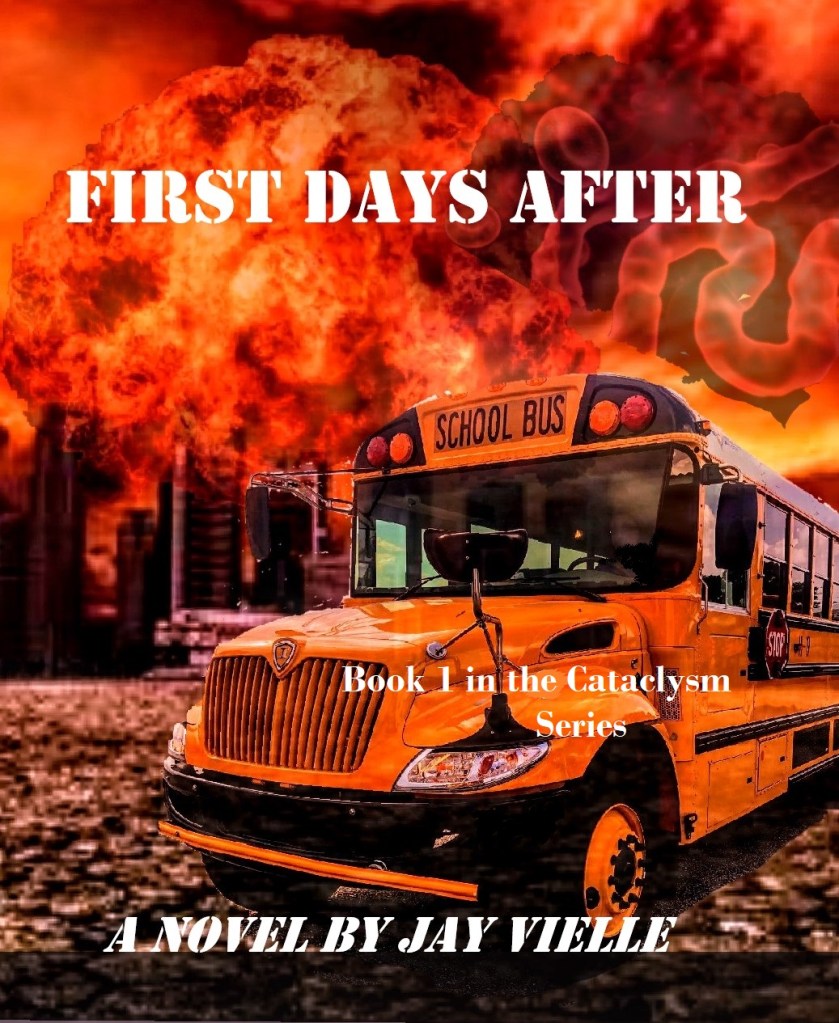
In the months just before the shutdown, I wrote nearly every day. Chapter after chapter. It started slowly at first. I wasn’t quite sure what I wanted my world to look like, who I wanted my characters to be…but after a while, it started to click. Kind of like your favorite sitcom. After a season or two, you start to know the characters, predict what they’ll say and do, and join them for their adventures gleefully. That happened to me about Chapter Four or so of my first book, “First Days After.”
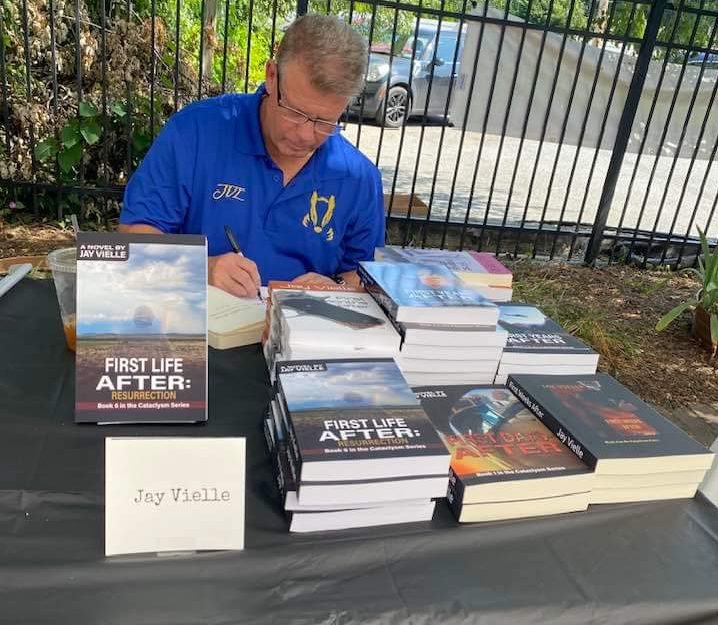
I started to know who my characters were and got a general idea of where they were headed–and then I just let my creativity take off. Fellow teachers would ask me how my progress was coming along. I knew it was going well when I would start getting into the plot and giving them daily updates. They were getting into it just from me verbalizing it for a few minutes. Before you knew it, I had a plot, a subplot, and started having a long-term vision of where this story might be headed–and it was headed way past a sequel.

Soon, I started to like my characters. I started being able to predict what they would do or say in the next chapter, or in a certain scenario. I got a flow going, and then things cascaded from there. I finished the first book, edited lightly for consistency once, then put it down for a while.

And then I abruptly started Book 2 right where I left off. The ending of Book 1 was purposefully written as a cliff hanger. You’re left exhausted at the end of a week-long quest that has nearly cost you your life several times, and now you’re faced with an entirely new one. That’s where Book 2, “First Weeks After” gets the ball and takes off running.
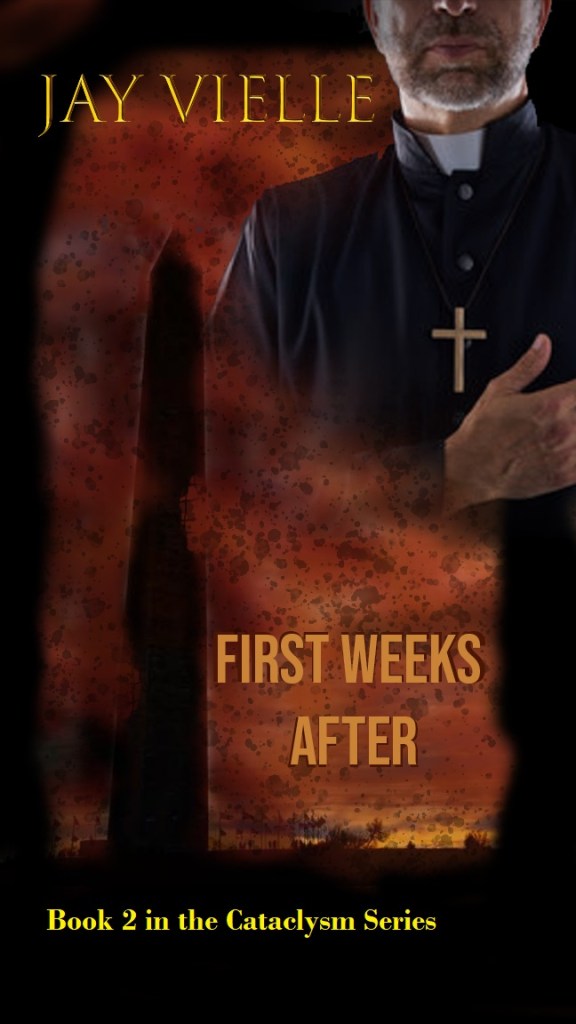
And by now, I had some villains lined up, several subplots running around in my head, and an indefinite time period to finish writing. It took me about a month and a half, but Book 2 ended (not surprisingly) with several groups of protagonists exhausted after harrowing quests and adventures–with a whole new set of problems awaiting them for Book 3– “First Months After”–which I am about halfway through as I write this blog.

So if you have ever thought you could write, then maybe you’re like me. Everyone has stories to tell. Not everybody may be as gifted at it as some. No matter what flow I get, I’ll never, never, ever be as good as some of my heroes: Bernard Cornwell, Robert B. Parker, Michael Crichton, Conn Iggulden, or Terry Brooks. I sometimes fear that one day I’ll run into one of them and develop a permanent inferiority complex.

But the truth is– and this took a while to realize, too–I don’t have to be as good as they are. Neither do you. Life isn’t all or nothing, no matter what you see on Facebook. If you’re like me, you’ve read plenty of books over the years, and most likely a third of them just made you say, “meh” afterwards. That’s okay. It doesn’t mean those books should never have been written, and it’s possible–not, it’s highly likely–that those same “meh” books touched someone else deep-down into their soul. There’s something for everyone. The goal is to find your voice, tell your stories, and improve yourself. That first novel I wrote 25 years ago was really mediocre. (I have a goal to one day go back and write it better). Since then I’ve read hundreds of books from dozens of authors. I started analyzing fiction the way I used to analyze film of my wrestlers. I’ve learned how to write better characters and develop them. I’ve learned how to pace myself better chapter by chapter. I’ve learned how to weave secondary events and characters into important plot twists farther along–something I never used to do–and I’ve done it by reading and imitating my iconic aforementioned modern literary heroes.

At this stage of my writing career, I’m a rookie in my fifth decade of life. My learning curve is going to have to be pretty sharp if I want to see the fruits of my labor before I die. In this blog I’m going to just talk about characters I’ve made, plots I’ve weaved, problems I’ve run into, time management issues, interruptions with my personal life, publishing challenges, and marketing…all hurdles that every author has to face eventually. And if you’ve decided to join me–please realize I’m making some of this up as I go along, and am far from an expert. But company on this rocky path is always welcome.

JVL
CHARACTERS: FROM CLAY TO SCULPTURE

Where did the idea(s) for the characters come from?

Well, the old adage is “write what you know.” In the case of characters, that would be “write who you know”–or whom you know–for the grammar junkies. So to start from scratch, I started with what I saw every day: my family, my work friends, and people I knew. That’s what I call “the clay.” It’s just a place to start–not a place to end. The sculptures–what I ended up with–are totally new people.

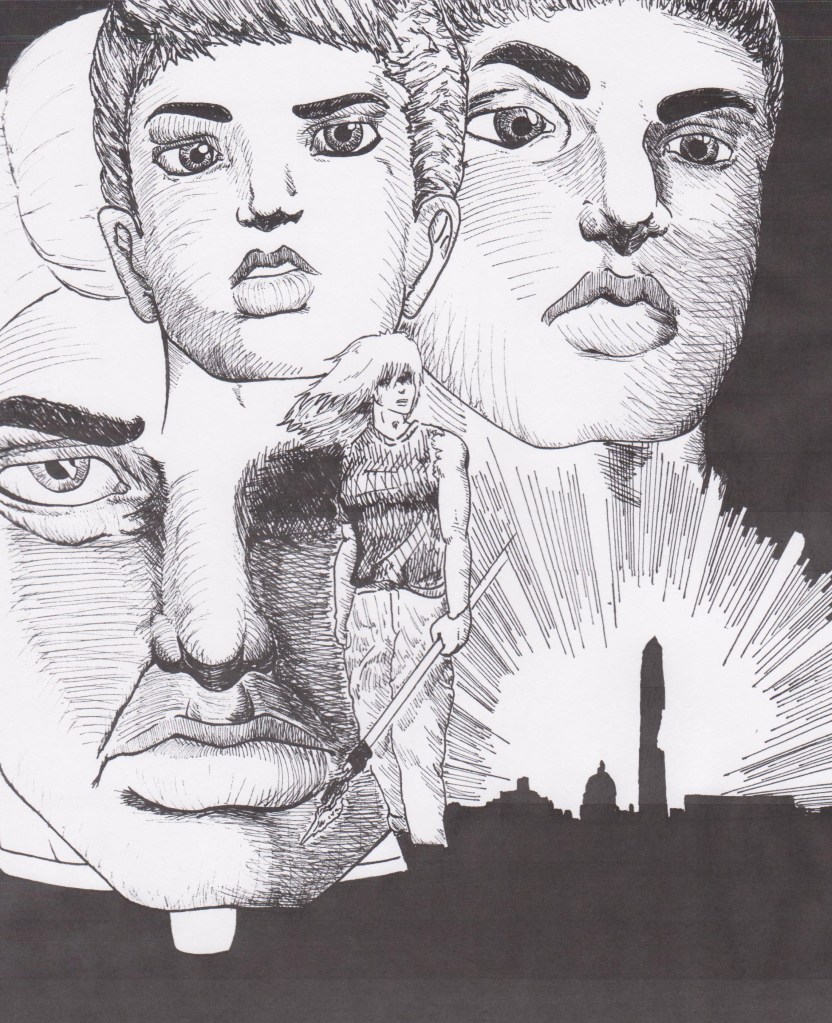
Of course, these characters may only resemble people I know–or knew–but they’re not real. But to get the ball rolling from nothing (which is where First Days After began), I started there. Let’s take a look at the characters and discuss where they came from. This interior cover art from First Weeks After is by artist Hunter Lowe, who also designed the outer cover for the Kindle version.

THE NARRATOR: EDUARDO (EDDIE) REYES

  • Eddie began from a real guy I used to have lunch with–Casey Whittaker. Casey was an openly gay English teacher in his 20’s. He used to come have lunch with the World Languages department because he got along well with the people there. Among them was the sponsor of our school’s “Gay-Straight Alliance”, or GSA–her name is Maureen. Obviously Casey would feel comfortable eating lunch with someone in her position. In addition, Maureen’s next door neighbor and good buddy, Kelly, helped her with GSA and also led our International Club–which was a proponent of all backgrounds, colors, and ethnicities joining as one. Those two, some of the most welcoming and tolerant individuals I know, became the character Maureen Kelly, and fuse many of their personality traits and points of view into a single person.
  • Of course, lunchtime is an opportunity to chat, tell stories, and laugh at ourselves. Casey brought an interesting humor and perspective to our discussions, and one day I simply knew that he had to be my Narrator. Oddly, I am not gay nor do I help Maureen or Kelly out with either of their clubs–but by having Casey’s voice in the back of my head, I felt like I could tell my story in his voice. Eddie Reyes is Peruvian–Casey is not–but as a Spanish teacher I’ve always been fascinated by Peru, and knew something about the culture there–so I made Eddie Hispanic and Peruvian so that I could occasionally slip in some culture to add flavor to the book.

THE PROTAGONIST: JAKE FISHER

Jake Fisher— My hero’s name comes from two of the most physically imposing wrestlers I ever coached in my 30+ year career: Jake Utz and Kyle Fisher. Both were state place-winning athletes and great kids–now great men. Those two looked like superheroes before they reached the age of 16. I always wished I could steal their respective DNA–but alas, the technology isn’t there yet. Jake Fisher, I will admit, looks and sounds a little like me. He’s not me– I would love to be Jake Fisher, but I fall woefully short. But there are things about Jake that are similar (write what you know, right?), so let’s start there. He’s a wrestling coach, a teacher, walks with a limp, has a metal hip, and is middle-aged. Much of his smart-ass humor is my own, admittedly, and his rough edges combined with a deep tolerance of other cultures and perspectives also poses a resemblance to the author. I truly don’t care what you look like, “who you kiss, or where you piss,” as Jake likes to say. Jake’s Marine Corps background, however, skips a generation. My father and my uncle were World War II Marines who enlisted very young. My dad actually had to get special dispensation to enlist at age 16 to go to war with his 20-year-old brother– my uncle, after whom I’m named. While not “dyed-in-the-wool” Marines, my dad and uncle ran particularly tight ships in both their private and professional lives. There were required manners of ‘yes sir, no sir, I’ll find out sir, or no excuse sir’ when I was growing up. Authority was never questioned in public, and a certain order, level of personal toughness, and work ethic were expected. I also needed Jake to be dangerous. And a wrestling coach who dabbled in martial arts who was trained by the Marines is dangerous. As for his experience with the Marine Corps’ Officer Candidate School and World Class Athlete Program for Greco-Roman wrestling? That was my dream. I tried to go into the Marines’ OCS just after graduate school in 1993, but due to field promotions making the officer pool top-heavy after the 1991 Persian Gulf conflict in Iraq, the Marines told me they weren’t taking officers. At age 27 with a Master’s Degree in English Literature and a Bachelor’s in Spanish & English, I didn’t want to enlist for another four years and hope for the chance to wrestle. I never got to do that–so I let Jake do it for me.

There are other things about Jake’s personality & situation that are NOT me: I’m not driven by guilt, as he obviously is. I’m not estranged from my wife, nor are we “empty-nesters”, and my two sons are not in college on wrestling scholarships. (My eldest son, Hunter, did wrestle briefly for a time in Division III at Wilkes University in Pennsylvania, but not in Virginia). My sons and I do not make a habit of fighting (we see a big brawl between Jake, Tommy, and Vinny Fisher in First Weeks After at the Pentagon). My wife is not a traveling pharmaceutical salesperson, and while I’m sure she might want to kill me from time to time, she has never actually ordered mutated creatures to do so (as Laura Fisher does in First Weeks After in the Smithsonian Metro). My fictional family might resemble my own from a distance–but the similarities end there. Any conflicts, feelings, or angst in my characters come from their own personalities and not from the real world.

WENDY AND THE COLONEL — These two, I will admit, are pretty close to the mark. These characters resemble their real-world models in a number of ways–though not all of them.

Wendy Yubashiri is actually Wendy Perzinski. She, too, is partially Japanese, and while the real Wendy’s personality is very similar to her character’s, her job is not. Real Wendy is a permanent substitute teacher who works at our school. I needed a disease specialist from NIH–so I just put her personality into a character I needed. It’s easier for me to write a character if I already know his/her personality–otherwise I have to ramp up the creativity a few notches. And as for the hinted Jake-Wendy romance? Total fiction. I needed Jake to struggle with mixed feelings of guilt, duty, and attraction during his heroic pursuits. All of that, too, is completely fabricated. Real Wendy is happily married with three daughters.

Col. Raymond Cannaveral— he comes dangerously close to the real thing–but how I arrived there is a very cool story of coincidence, luck and happenstance. The real Colonel (Ray Naworhol–pronounced like Cannaveral without the ‘can’) is my work neighbor. He is a JROTC instructor, retired from the Army, and has tons of experience, including Iraq and the Pentagon. When I began writing First Days After, I realized I needed a military leader, so I decided to use Ray. Again–it’s “write what you know”–and I had been on the grounds at Fort Detrick years ago when I was teaching at Frederick Community College and an old college chum was assigned there. I decided to make the fake Colonel into a chemical and biological weapons specialist at Fort Detrick. Total fabrication from my brain…until one day in the hall, I updated him on the progress of my book, and told him what I’d done with his character. He answered back, “Yeah, I used to do that.” “Do what?” I said. “Exactly that job,” he said. “No shit! Really?” I replied. I grabbed my pen and notebook and started pelting him with questions. The information he provided makes the series more believable–if you can find it believable at all. He told me about things I never knew existed (nothing classified)–like CBRNE and Site R. He helped me fill in details that would make the “willing suspension of disbelief” much easier on the reader. The real Colonel is a true dyed-in-the-wool Army man, a gentleman, and a caring leader. I wanted to do the real man justice with his avatar in the book, and I can’t thank him enough for his friendship and guidance on this.

THE VILLAINS: WES KENT, FATHER JOE, & LOU ORVILLE

I have to say, these guys are all completely made up. The names are partially borrowed from friends I have who wanted a place in the book, but the characters are totally fictitious in every way. In Father Joe, I wanted a slippery, subtle, charismatic pastor type who looks on the surface to be the most pleasant and reasonable of sorts–but who, down deep, is a megalomaniacal evil genius. In Wes Kent— who, I admit the name is a melding of two of my friends–Wes Winters and Jeff Kent. The character is no more like either one of them than a hawk is to a handsaw. Book Wes needed to be power-hungry, and a smooth talker like Father Joe, but on a slightly smaller scale. I knew a “Father Joe” in real life many years ago, but have not seen him in a lifetime, and the name is coincidental as well. Lou Orville‘s name comes from another friend, Lou Orem–but the character is a dull, fairly slow-witted and insecure bully. My friend Lou is none of those–and in fact the opposite in every regard. Real Lou is a sweet, caring, and well-educated wrestling coach. For some reason it was easier for me to create interesting villains from my head than it was to create interesting “good guys.”

SECONDARY CHARACTERS: AL, ESTELA, PABLO, & MORGAN

I used to teach with a guy named Al DeGennaro, a wonderful, bright, and pleasant man many years my elder who passed away recently. I imagined what he might have been like as a young man, and gave his character, Al DePhillipo, a similar name–but the truth is, this character is completely fictional, which may explain why I haven’t developed him more…because I don’t yet know who he really is. In Pablo Fuentes, I needed an erudite man with strong religious ideals. I have borrowed the personality of an old colleague of mine, Pedro Fernandez of Spain. But therein end the similarities. Pedro taught high school Latin and Spanish from North Carolina to Maryland, and then eventually moved back to Europe, and I’m not sure if he ever married or not. Pablo taught in Mexico, married, lost a wife, turned to drinking, and then became an extremist. Pablo’s daughter, Estela, is completely fictional. Her story, however–which we see much more clearly in First Weeks After–is one I have heard many times. For me she represents the young lesbian woman struggling to find herself, find love, and find acceptance–and unfortunately unable to find any of that in her father. Her story unfortunately is way, way too common these days, and was a perspective I thought needed to be represented. Morgan, on the other hand, is based on a real person. She was one of my all-time favorite Spanish students with whom I discussed the progress of Book 1 as it was being drafted. One day, she asked if she could be a character. Real Morgan is openly gay herself, and told me how much it meant to her to have a gay narrator, but as I told her the story, she pointed out (rightly) that Eddie has no love interests in the book, and that in some ways, he was gay for the sake of being gay. Despite my protestations that his voice was that of my colleague mentioned above, she said that this book was a chance to touch on a number of social issues, and challenged me to do something substantive for a gay character. I promised that day to make her a character, and so I made her a friend of Vinny‘s in college and a love interest of Estela‘s–an ARC I wanted to represent. I needed the fictional Morgan to be a war orphan whose family was lost in the Washington D.C. attacks–and as such allow her to join our team of heroes from Emmitsburg. A delightful young lady, the real Morgan inspired me to keep writing on days when I was exhausted or depressed–just so she could see where the story was heading. The result was a great, tangled web of Estela turning out to be Pablo‘s daughter, having lied to everyone about her background out of guilt and embarrassment. Like she did to me, Morgan‘s character challenges Estela to be a better version of herself, and together they crack open the corrupt Church of Many Blessings and its pastor’s ties to Russian militants.

THE CHURCHThe Church of Many Blessings is NOT intended to be any church I’ve ever had any personal contact with, and any resemblance is purely coincidental. I did, however, want the villains of my book to represent intolerance, white supremacy, and self-indulgence. I’m a pretty ‘middle-of-the-road’ kinda guy who is a registered independent voter. I don’t believe in labels, or political parties representing my views, but if I have to pick a side of the fence, I’ll stand firm against those three ideas any day. With the unfortunate amount of self-proclaimed “Christians” I have seen lately who represent the above qualities, however, it seemed to be a great place to set my villains’ stronghold. It is no new idea since the dawn of Christianity, charismatic church leaders have led their flocks into directions that some might ironically consider “un-Christian”. I consider myself nondenominational, and while was a two-year president of the Fellowship of Christian Athletes in college, and helped start the huddle at the school where I now teach when it opened twenty years ago… I will be the first to admit that my notions of Christianity don’t necessarily fall into the mainstream.

While I’m not truly NOT trying to make any kind of statement with all of this, I do think it’s healthy for anyone in a collective congregation to do some introspection and really examine what their church and their pastors stand for. That can never hurt.

SETTINGS: EMMITSBURG, DC, & VIRGINIA

How I decided where to put my fictional high school and where the adventures of Jake Fisher and his friends would take place.

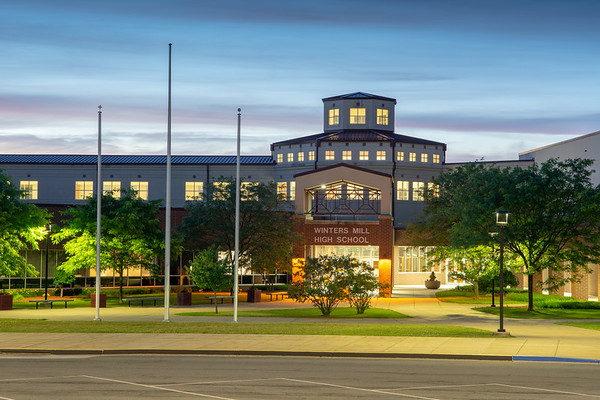
HUNTER’S RUN HIGH SCHOOL— Obviously not a real place–in fact, at the time of this blog, there are no high schools in Emmitsburg at all… but I definitely had some schools in mind when writing about it. Century and Winters Mill High Schools in Carroll County, Maryland are twins. They share about 90-95% of the same architecture–and though smaller places within them have their own unique touches and colorations, it was the blueprint of those two schools (in which I have spent a lot of my real life working time) that I began with in my head. When I describe locations (in both currently published books–and also now in Book 3–“First Months After”), it is Winters Mill that I am describing for the most part.

Winters Mill High School (photo by Thomas Walker photography)

Why Emmitsburg?

EMMITSBURG, MARYLAND is a small town just north of Carroll County, where I reside. It’s just over the county line into Frederick County, and is surrounded by farmland, creeks and rivers, and the beautiful Catoctin Mountains. It is the home of the Shrine of Elizabeth Seton, the Grotto of Lourdes, and Mount St. Mary’s University–all of which are some of the most sacred and beautiful places you’re ever likely to set foot in. I visit there all the time when I need to get away and reflect. The town itself has the kind of architecture and “main street layout” that you see in many small Pennsylvania towns–and in those border counties, the “PA influence” can be seen for miles. The Emmitsburg of The Cataclysm Series, however, is totally of my own making. The fictional Church of Many Blessings and its proximity to Hunter’s Run High School are handy for my plot–but don’t look for either when you go to Emmitsburg. You also won’t find a Wal-Mart there, either–but I needed one for the plot as well. You have to travel a good twenty minutes in any direction to find one.

MT. ST. MICHEAL’S UNIVERSITY— Let’s not kid ourselves–with such an influential, gorgeous place like the real-life Mt. St. Mary’s, I couldn’t leave out a college in the town, so I created a fictional one to take its place, not wishing to offend the real school with anything plot or theme-related in my stories. You can’t go to a college town for your novel and omit the college–so I morphed one into another for fictitious purposes.

FORT DETRICK— Fort Detrick in Frederick, Maryland is a real place that actually focuses on the same types of things I put in my book. Other than that, however, I didn’t want to spend much time in a government institution for Book 1, First Days After. It’s a place that would undertake the study of biochemical weapons defense, the kind of place that both the real and the fictitious Colonels would work. It is also a major employer and phenomenon in the city of Frederick.

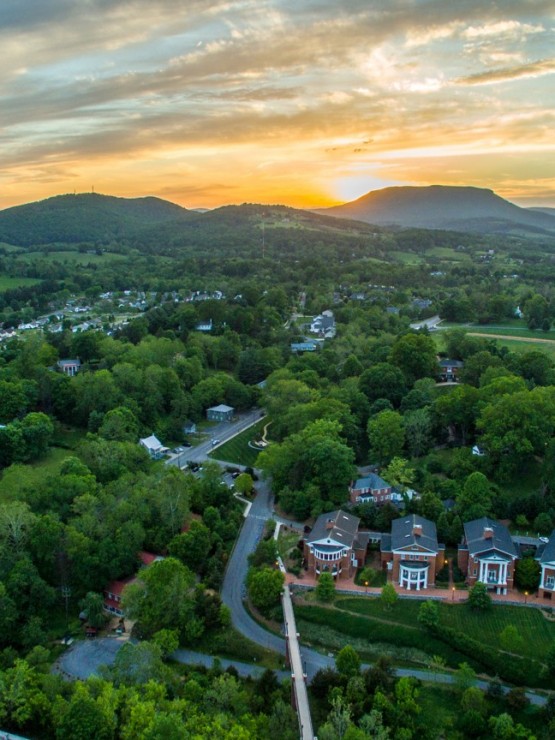
LEXINGTON, VIRGINIA— Lexington is the town I lived in for five years while studying for my Bachelor’s Degree and my teaching certification. As an alumnus of Washington & Lee University, I spend a good bit of time at both W&L and Virginia Military Institute, (VMI) literally next door. Both wrestling teams would work out together, and I got to know coaches and athletes well there over the years. Both schools are fantastic and historically significant institutions, and Lexington remains one of my favorite places in the whole world–I just couldn’t leave it out of a book that I wrote. Virginia Tech–where Jake’s youngest son attends on a wrestling scholarship, is a place where I took my high school wrestling team to camp back in 2016. It’s also gorgeous–“big school gorgeous”–in ways that VMI and W&L are “small school gorgeous.”

Lexington, Virginia

FRONT ROYAL, VIRGINIA— another of my favorite towns. I used to stop in there on my way home from school from time to time, and where I took my family a number of times on day and weekend trips around Skyline Drive and Luray Caverns. Front Royal would be an awesome place to have settled down had I lived in Virginia. It truly has it all from traditional rural attractions to burgeoning development as a small city. I needed a place on the way to Washington, DC from southwestern Virginia in order to create the setting behind my post-Apocalyptic, convict-led town. For those scenes, I was thinking a little in my Mad Max mentality. I wanted a place where lawlessness ruled, and the real danger to post-Apocalyptic thinking could germinate and take hold of the imagination. It is there, ironically, in First Days After, that the last shred of decency in one of the convicts–Nick–is exploited and used by the Colonel, who recognizes his own influence on the young man, and talks him into considering a coup d’état to overthrow the tyrannical and diabolical leader, Lawrence.

THE ANACOSTIA RIVER, THE PENTAGON, AND THE NATIONAL MALL

The areas along the Anacostia, featured in Book 2, First Weeks After, are again of my personal preference, and ones that–in my personal opinion–are undervalued. I have been to the National Arboretum many times, and loved it with each visit. I always wondered why the place wasn’t mobbed with people, its beauty so evident to me. I think perhaps it needs a publicist–but then, massive crowds might mar the beauty of its gardens, paths, and creations. As for the Bladensburg Waterfront–I have never been there. I needed a place for Jake to grab boats to make it into Washington DC proper, and a quick check on Google Maps did the trick. From there I backtracked to potential stables outside the DC Beltway, and created one in Glenmont near the real-life Wheaton Stables, which I have also never visited. Google provided both of those places for me. Like Jake, I needed to plot a path from outside the beltway to the National Mall, and the on-line maps helped me create that path. The National Mall is a place that probably millions have seen over the years, and I thought it would just be a really, really cool place to chase down some mutates. The monuments and buildings there are so well-known and iconic, I thought they might really fire up the imagination of the readers. The Pentagon is well-known too–though I have never been there. My research on it, along with Google Images and Maps, allowed me to put just enough there to make it realistic–and the real life Colonels tales of CBRNE’s abilities filled in the rest.

Gardens in the National Arboretum

HORSES AND BOATS— Growing up in the country on Maryland’s Eastern Shore, I spend the bulk my youth on the back of a horse or in the hull of a boat. We had what my dad called a “Gentleman’s Farm,” which, by most accounts, would equate to what we now call a “homestead” today–albeit one with running water and electricity. We had, at our peak, eight horses, three beef cattle, five goats, four geese, and a hundred chickens–not to mention a vegetable garden that was well over an acre in size by itself. We had two ponds and waterfront on the Chesapeake Bay’s inlet of Cummings Creek. We hunted, fished, crabbed, gathered oysters, farmed, and planted. It was a lifestyle that I’m now thankful I got to experience as a kid–though admittedly, that kid didn’t like having to shovel all that manure quite so often. I’d love to devote one of the books to the Eastern Shore one day. It’s like no other place on Earth, in some ways a land forgotten and a lifestyle that is dwindling and endangered. At any rate, it was that background that pushed me to put horses and boats in First Weeks After. Those two methods of slipping past barricades would immediately appeal to me–so I had them appeal to Jake Fisher as well.