Where did the idea(s) for the characters come from?
Well, the old adage is “write what you know.” In the case of characters, that would be “write who you know”–or whom you know–for the grammar junkies. So to start from scratch, I started with what I saw every day: my family, my work friends, and people I knew. That’s what I call “the clay.” It’s just a place to start–not a place to end. The sculptures–what I ended up with–are totally new people.
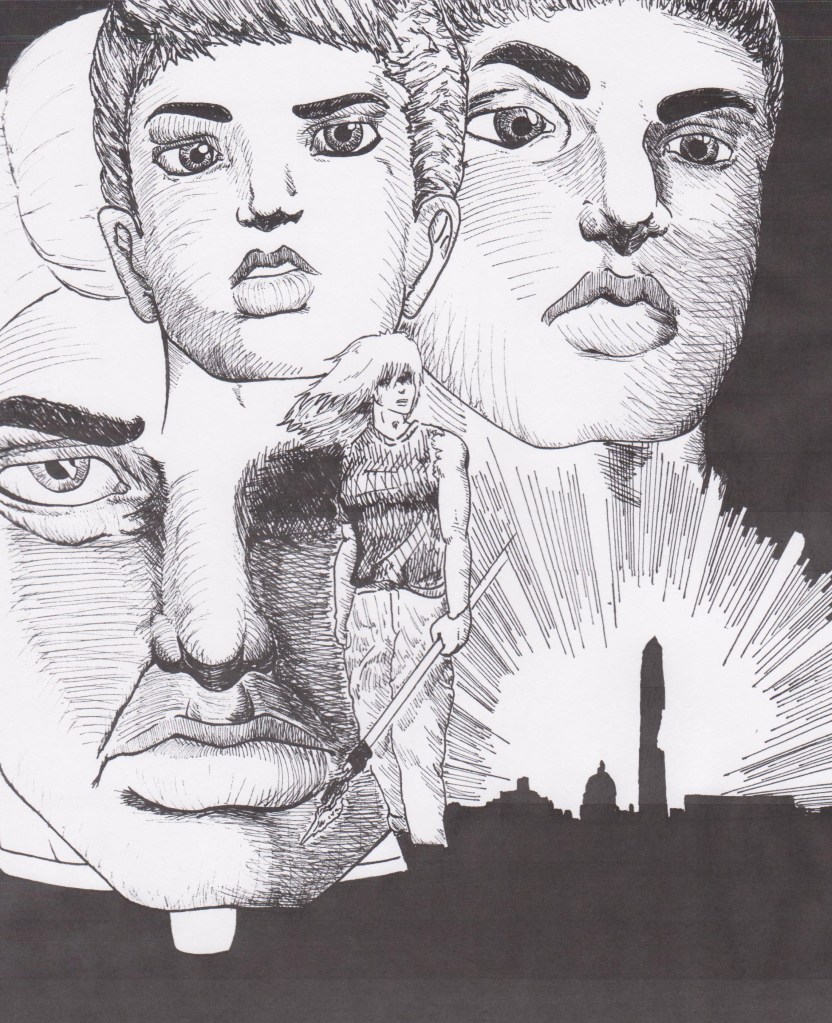
Of course, these characters may only resemble people I know–or knew–but they’re not real. But to get the ball rolling from nothing (which is where First Days After began), I started there. Let’s take a look at the characters and discuss where they came from. This interior cover art from First Weeks After is by artist Hunter Lowe, who also designed the outer cover for the Kindle version.
THE NARRATOR: EDUARDO (EDDIE) REYES
- Eddie began from a real guy I used to have lunch with–Casey Whittaker. Casey was an openly gay English teacher in his 20’s. He used to come have lunch with the World Languages department because he got along well with the people there. Among them was the sponsor of our school’s “Gay-Straight Alliance”, or GSA–her name is Maureen. Obviously Casey would feel comfortable eating lunch with someone in her position. In addition, Maureen’s next door neighbor and good buddy, Kelly, helped her with GSA and also led our International Club–which was a proponent of all backgrounds, colors, and ethnicities joining as one. Those two, some of the most welcoming and tolerant individuals I know, became the character Maureen Kelly, and fuse many of their personality traits and points of view into a single person.
- Of course, lunchtime is an opportunity to chat, tell stories, and laugh at ourselves. Casey brought an interesting humor and perspective to our discussions, and one day I simply knew that he had to be my Narrator. Oddly, I am not gay nor do I help Maureen or Kelly out with either of their clubs–but by having Casey’s voice in the back of my head, I felt like I could tell my story in his voice. Eddie Reyes is Peruvian–Casey is not–but as a Spanish teacher I’ve always been fascinated by Peru, and knew something about the culture there–so I made Eddie Hispanic and Peruvian so that I could occasionally slip in some culture to add flavor to the book.
THE PROTAGONIST: JAKE FISHER
Jake Fisher— My hero’s name comes from two of the most physically imposing wrestlers I ever coached in my 30+ year career: Jake Utz and Kyle Fisher. Both were state place-winning athletes and great kids–now great men. Those two looked like superheroes before they reached the age of 16. I always wished I could steal their respective DNA–but alas, the technology isn’t there yet. Jake Fisher, I will admit, looks and sounds a little like me. He’s not me– I would love to be Jake Fisher, but I fall woefully short. But there are things about Jake that are similar (write what you know, right?), so let’s start there. He’s a wrestling coach, a teacher, walks with a limp, has a metal hip, and is middle-aged. Much of his smart-ass humor is my own, admittedly, and his rough edges combined with a deep tolerance of other cultures and perspectives also poses a resemblance to the author. I truly don’t care what you look like, “who you kiss, or where you piss,” as Jake likes to say. Jake’s Marine Corps background, however, skips a generation. My father and my uncle were World War II Marines who enlisted very young. My dad actually had to get special dispensation to enlist at age 16 to go to war with his 20-year-old brother– my uncle, after whom I’m named. While not “dyed-in-the-wool” Marines, my dad and uncle ran particularly tight ships in both their private and professional lives. There were required manners of ‘yes sir, no sir, I’ll find out sir, or no excuse sir’ when I was growing up. Authority was never questioned in public, and a certain order, level of personal toughness, and work ethic were expected. I also needed Jake to be dangerous. And a wrestling coach who dabbled in martial arts who was trained by the Marines is dangerous. As for his experience with the Marine Corps’ Officer Candidate School and World Class Athlete Program for Greco-Roman wrestling? That was my dream. I tried to go into the Marines’ OCS just after graduate school in 1993, but due to field promotions making the officer pool top-heavy after the 1991 Persian Gulf conflict in Iraq, the Marines told me they weren’t taking officers. At age 27 with a Master’s Degree in English Literature and a Bachelor’s in Spanish & English, I didn’t want to enlist for another four years and hope for the chance to wrestle. I never got to do that–so I let Jake do it for me.
There are other things about Jake’s personality & situation that are NOT me: I’m not driven by guilt, as he obviously is. I’m not estranged from my wife, nor are we “empty-nesters”, and my two sons are not in college on wrestling scholarships. (My eldest son, Hunter, did wrestle briefly for a time in Division III at Wilkes University in Pennsylvania, but not in Virginia). My sons and I do not make a habit of fighting (we see a big brawl between Jake, Tommy, and Vinny Fisher in First Weeks After at the Pentagon). My wife is not a traveling pharmaceutical salesperson, and while I’m sure she might want to kill me from time to time, she has never actually ordered mutated creatures to do so (as Laura Fisher does in First Weeks After in the Smithsonian Metro). My fictional family might resemble my own from a distance–but the similarities end there. Any conflicts, feelings, or angst in my characters come from their own personalities and not from the real world.
WENDY AND THE COLONEL — These two, I will admit, are pretty close to the mark. These characters resemble their real-world models in a number of ways–though not all of them.
Wendy Yubashiri is actually Wendy Perzinski. She, too, is partially Japanese, and while the real Wendy’s personality is very similar to her character’s, her job is not. Real Wendy is a permanent substitute teacher who works at our school. I needed a disease specialist from NIH–so I just put her personality into a character I needed. It’s easier for me to write a character if I already know his/her personality–otherwise I have to ramp up the creativity a few notches. And as for the hinted Jake-Wendy romance? Total fiction. I needed Jake to struggle with mixed feelings of guilt, duty, and attraction during his heroic pursuits. All of that, too, is completely fabricated. Real Wendy is happily married with three daughters.
Col. Raymond Cannaveral— he comes dangerously close to the real thing–but how I arrived there is a very cool story of coincidence, luck and happenstance. The real Colonel (Ray Naworhol–pronounced like Cannaveral without the ‘can’) is my work neighbor. He is a JROTC instructor, retired from the Army, and has tons of experience, including Iraq and the Pentagon. When I began writing First Days After, I realized I needed a military leader, so I decided to use Ray. Again–it’s “write what you know”–and I had been on the grounds at Fort Detrick years ago when I was teaching at Frederick Community College and an old college chum was assigned there. I decided to make the fake Colonel into a chemical and biological weapons specialist at Fort Detrick. Total fabrication from my brain…until one day in the hall, I updated him on the progress of my book, and told him what I’d done with his character. He answered back, “Yeah, I used to do that.” “Do what?” I said. “Exactly that job,” he said. “No shit! Really?” I replied. I grabbed my pen and notebook and started pelting him with questions. The information he provided makes the series more believable–if you can find it believable at all. He told me about things I never knew existed (nothing classified)–like CBRNE and Site R. He helped me fill in details that would make the “willing suspension of disbelief” much easier on the reader. The real Colonel is a true dyed-in-the-wool Army man, a gentleman, and a caring leader. I wanted to do the real man justice with his avatar in the book, and I can’t thank him enough for his friendship and guidance on this.
THE VILLAINS: WES KENT, FATHER JOE, & LOU ORVILLE
I have to say, these guys are all completely made up. The names are partially borrowed from friends I have who wanted a place in the book, but the characters are totally fictitious in every way. In Father Joe, I wanted a slippery, subtle, charismatic pastor type who looks on the surface to be the most pleasant and reasonable of sorts–but who, down deep, is a megalomaniacal evil genius. In Wes Kent— who, I admit the name is a melding of two of my friends–Wes Winters and Jeff Kent. The character is no more like either one of them than a hawk is to a handsaw. Book Wes needed to be power-hungry, and a smooth talker like Father Joe, but on a slightly smaller scale. I knew a “Father Joe” in real life many years ago, but have not seen him in a lifetime, and the name is coincidental as well. Lou Orville‘s name comes from another friend, Lou Orem–but the character is a dull, fairly slow-witted and insecure bully. My friend Lou is none of those–and in fact the opposite in every regard. Real Lou is a sweet, caring, and well-educated wrestling coach. For some reason it was easier for me to create interesting villains from my head than it was to create interesting “good guys.”
SECONDARY CHARACTERS: AL, ESTELA, PABLO, & MORGAN
I used to teach with a guy named Al DeGennaro, a wonderful, bright, and pleasant man many years my elder who passed away recently. I imagined what he might have been like as a young man, and gave his character, Al DePhillipo, a similar name–but the truth is, this character is completely fictional, which may explain why I haven’t developed him more…because I don’t yet know who he really is. In Pablo Fuentes, I needed an erudite man with strong religious ideals. I have borrowed the personality of an old colleague of mine, Pedro Fernandez of Spain. But therein end the similarities. Pedro taught high school Latin and Spanish from North Carolina to Maryland, and then eventually moved back to Europe, and I’m not sure if he ever married or not. Pablo taught in Mexico, married, lost a wife, turned to drinking, and then became an extremist. Pablo’s daughter, Estela, is completely fictional. Her story, however–which we see much more clearly in First Weeks After–is one I have heard many times. For me she represents the young lesbian woman struggling to find herself, find love, and find acceptance–and unfortunately unable to find any of that in her father. Her story unfortunately is way, way too common these days, and was a perspective I thought needed to be represented. Morgan, on the other hand, is based on a real person. She was one of my all-time favorite Spanish students with whom I discussed the progress of Book 1 as it was being drafted. One day, she asked if she could be a character. Real Morgan is openly gay herself, and told me how much it meant to her to have a gay narrator, but as I told her the story, she pointed out (rightly) that Eddie has no love interests in the book, and that in some ways, he was gay for the sake of being gay. Despite my protestations that his voice was that of my colleague mentioned above, she said that this book was a chance to touch on a number of social issues, and challenged me to do something substantive for a gay character. I promised that day to make her a character, and so I made her a friend of Vinny‘s in college and a love interest of Estela‘s–an ARC I wanted to represent. I needed the fictional Morgan to be a war orphan whose family was lost in the Washington D.C. attacks–and as such allow her to join our team of heroes from Emmitsburg. A delightful young lady, the real Morgan inspired me to keep writing on days when I was exhausted or depressed–just so she could see where the story was heading. The result was a great, tangled web of Estela turning out to be Pablo‘s daughter, having lied to everyone about her background out of guilt and embarrassment. Like she did to me, Morgan‘s character challenges Estela to be a better version of herself, and together they crack open the corrupt Church of Many Blessings and its pastor’s ties to Russian militants.
THE CHURCH— The Church of Many Blessings is NOT intended to be any church I’ve ever had any personal contact with, and any resemblance is purely coincidental. I did, however, want the villains of my book to represent intolerance, white supremacy, and self-indulgence. I’m a pretty ‘middle-of-the-road’ kinda guy who is a registered independent voter. I don’t believe in labels, or political parties representing my views, but if I have to pick a side of the fence, I’ll stand firm against those three ideas any day. With the unfortunate amount of self-proclaimed “Christians” I have seen lately who represent the above qualities, however, it seemed to be a great place to set my villains’ stronghold. It is no new idea since the dawn of Christianity, charismatic church leaders have led their flocks into directions that some might ironically consider “un-Christian”. I consider myself nondenominational, and while was a two-year president of the Fellowship of Christian Athletes in college, and helped start the huddle at the school where I now teach when it opened twenty years ago… I will be the first to admit that my notions of Christianity don’t necessarily fall into the mainstream.
While I’m not truly NOT trying to make any kind of statement with all of this, I do think it’s healthy for anyone in a collective congregation to do some introspection and really examine what their church and their pastors stand for. That can never hurt.
 Writing with Jay Vielle